

Professional Tool
Garage Door Spring
Calculator
Enter your existing spring specs to instantly calculate IPPT, torque, and the correct replacement spring length — even when switching wire sizes or spring count.
Current / Broken Spring
Current Spring Stats
Enter spring specs above to see results.
Replacement Spring
Direct Replacement
Results appear here after entering current spring data.
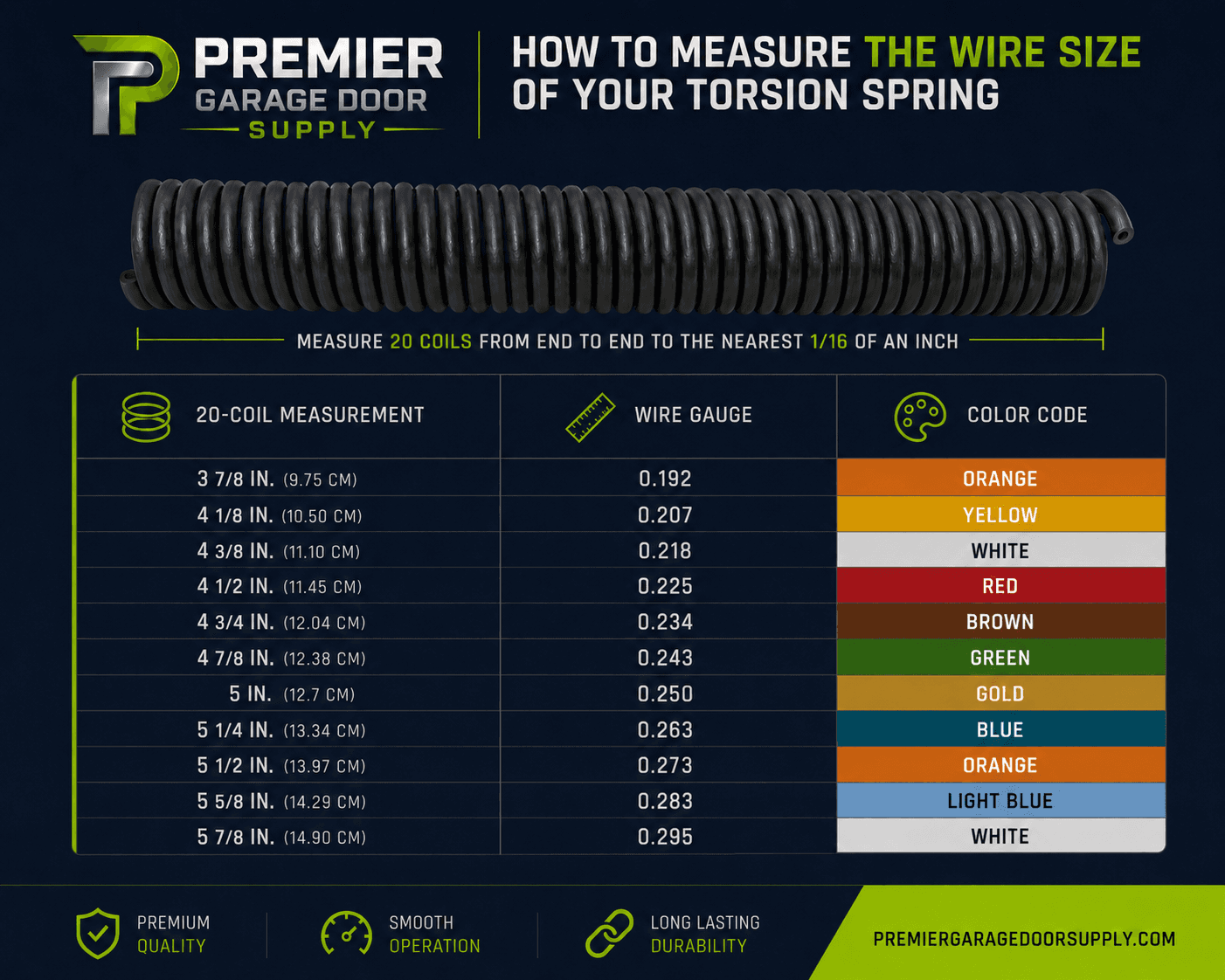
Garage Door Spring Size Reference Chart
Use this torsion spring conversion chart to identify your spring specs before calculating.
Need the spring?
We stock a full range of high-cycle electrophoretic coated torsion springs. Call us or shop online.
Step-by-Step Guide
How to Measure Your Garage Door Spring
Accurate measurements are the foundation of a correct spring order. Here is exactly what to measure and how to measure it before using the calculator above.
- 1
Measure the wire size
Measure 20 consecutive coils and use the size chart above to identify your wire size.
- 2
Measure the inside diameter
With the spring removed from the shaft, measure across the inside opening of the spring from one inner edge to the opposite inner edge. Standard residential inside diameters are 1-3/4 inch (1.75) and 2 inch (2.00).
- 3
Measure the spring length
Lay the spring on a flat surface in its relaxed, unwound state. Measure from one end to the other end. Record in inches — for example, 32 or 28.5 inches.
- 4
Count the number of springs
Look at the torsion bar above your garage door. A single spring is one coiled spring on the bar; a dual-spring setup has two springs, often with a gap at center.
- 5
Enter specs and read results
Enter wire size, inside diameter, length, and spring count for your current spring in Step 1 of the calculator above. Then select the replacement specs in Step 2. The required replacement length appears instantly.
Safety note
Always measure torsion springs in their fully unwound state. Never attempt to remove or install a wound torsion spring without proper winding bars and safety training — a fully wound spring stores significant energy. If you are unsure, call a professional.
Common Questions
Garage Door Spring Calculator FAQ
How do I calculate the correct replacement garage door spring?
To calculate a replacement torsion spring, you need three measurements from your existing spring: wire size (diameter of the wire), inside diameter, and overall length. Enter these into our garage door spring calculator above, along with the number of springs on your door. The tool calculates IPPT (inch-pounds per turn), total torque, and the exact replacement length — even if you are switching to a different wire size or going from one spring to two.
What is a torsion spring conversion chart and how do I use it?
A torsion spring conversion chart cross-references wire size, inside diameter, and length to help you identify a spring's specs when the label is worn or missing. You measure the spring physically and look up the closest standard size. Our reference chart above shows the most common residential torsion spring dimensions used in the US. Once you have identified your specs, enter them into the calculator to find the replacement length.
How do I measure a garage door torsion spring?
Measure the spring while it is fully unwound and relaxed. (1) Wire size: measure 20 consecutive coils and use the size chart to identify your wire size. (2) Inside diameter: measure the inside opening of the spring from one inner edge to the opposite inner edge. Common sizes are 1-3/4" and 2". (3) Spring length: measure the total length of the spring from end to end while it is unwound.
What does IPPT mean for garage door springs?
IPPT stands for Inch-Pounds Per Turn — the amount of torque a torsion spring produces for each full rotation. It is the primary measure of a spring's lifting force. When replacing a spring, the goal is to match the original IPPT (or total torque if going from 1 spring to 2) so the door opens and closes with the same force. Our calculator handles this automatically: enter your current spring specs and the replacement specs, and it solves for the correct length.
How do I know if my garage door needs 1 spring or 2 springs?
Most single-car residential garage doors (8-10 ft wide) run on one torsion spring. Wider or heavier doors — two-car doors (16 ft), solid wood doors, or doors with extra insulation — typically use two springs for balanced lifting and longer spring life. Check above the door on the horizontal torsion bar: one spring means a single-spring system, two springs means a double-spring setup. Our calculator supports both configurations.
Can I replace one broken spring with two springs?
Yes — switching from 1 spring to 2 springs is a common upgrade that distributes load more evenly and can double spring lifespan. Our calculator handles this conversion automatically. Set "Current Spring" to 1 spring, then set "Replacement Spring" to 2 springs. The calculator divides the total torque requirement between the two new springs and gives you the correct length for each.
What is the standard wire size for residential garage door torsion springs?
The most common wire sizes for residential torsion springs are 0.207, 0.218, 0.225, 0.234, 0.243, 0.250, and 0.262 inches. The right wire size for your door depends on door weight, height, and spring configuration. Heavier doors require thicker wire to generate more torque. Our calculator supports all standard residential wire sizes — select the size matching your current spring in Step 1.
Why is my replacement spring a different length than the original?
Replacement spring length changes when wire size, inside diameter, or spring count changes. A thicker wire at the same inside diameter produces more torque per coil, so you need fewer coils — and a shorter spring. Our calculator accounts for these relationships using the standard torsion spring formula (E x d^4 / 10.8 x D x N) to give you the mathematically exact replacement length, rounded to the nearest half inch.